
How this comes up in practice
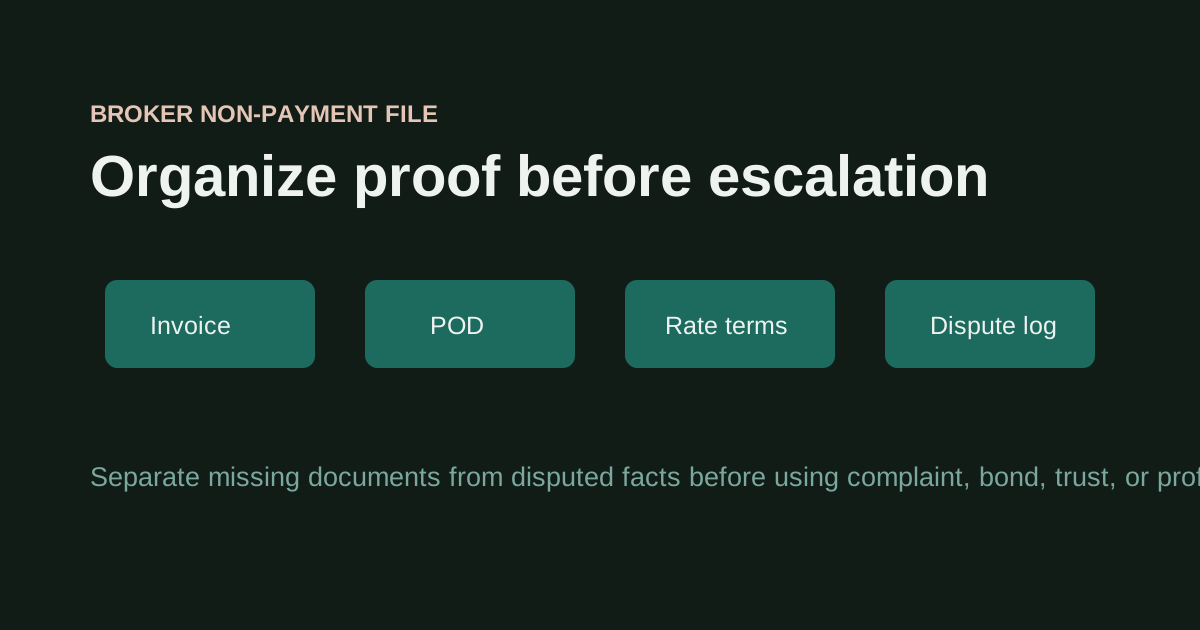
A carrier accepts a first load from an unfamiliar broker on 30-day payment terms. The MC number checks out in L&I with active authority and a bond on file. Thirty-two days after POD submission, the broker's accounting department stops responding. The bond on file gives the carrier a potential avenue for a claim, but working through a bond claim requires specific documentation, a clear timeline, and in some cases qualified review — none of which the carrier had organized before the dispute began. A search of the NCCDB complaint database before booking would have shown three resolved disputes and one pending in the prior year. That context wouldn't have prevented booking the load, but it would have shaped how the file was kept: more deliberate payment tracking from day one, a follow-up call before the deadline rather than after, and a prepared documentation file before the dispute window closed. Pre-booking payment research changes the documentation discipline for the load; it doesn't guarantee a different outcome, but it puts the file in better shape when an outcome needs to be addressed.
What payment history tells you before a booking — and what it doesn't
Broker payment history research before a first booking produces context, not conclusions. A NCCDB search that returns no complaints doesn't mean a broker has never had a dispute — it means no eligible, processed complaints are publicly visible. A search that returns past complaints doesn't mean the broker is currently unreliable — it means there's a record worth factoring into how closely the current transaction is documented. For adjacent verification steps, compare this with Broker Credit Check Basics, Broker Non-Payment Checklist, and Broker Bond / BMC-84 / BMC-85 Explained.
The more actionable research is direct: written payment terms on the rate confirmation that are specific and consistent with expectations, a broker entity that checks out in L&I with active authority and a current financial responsibility filing, and a main office contact confirmed through the L&I record rather than only through the booking email thread. Those three checks answer questions about the current load; payment history research answers questions about pattern.
Using payment signals together — official records, written terms, complaint context — gives the documentation a basis that a single lookup doesn't. When a dispute arises, the file built during booking is more useful than one assembled after the fact. That's the practical purpose of a payment history review: it shapes the documentation discipline for the load, not just the decision of whether to book it.
Key Takeaways
- Check broker authority and financial responsibility in FMCSA Licensing & Insurance.
- Compare the MC number, legal name, address, phone, and email domain against independent records.
- Review the rate confirmation before pickup, including shipper, lane, commodity, and payment terms.
- Save the original email headers, rate confirmation, packet, and payment instructions.
Reviewing broker payment signals through the written transaction record
Payment history review is not a credit bureau lookup — it's a documentation exercise. The most reliable signals come from what's observable in writing: the terms on the rate confirmation, whether invoices are acknowledged or disputed, whether payment instructions stay consistent across loads from the same entity, and whether the broker responds to payment inquiries through a contact channel you can verify independently.
The NCCDB complaint search is one data point, not a verdict. A broker with no complaints may still have an active dispute in progress, and a broker with some complaint history may have resolved them and changed practices. What matters most is the specific transaction record in front of you and whether the written documentation supports the payment claim.
Reviewing broker payment signals through the written transaction record checklist
- Whether rate confirmation payment terms are written, specific, and consistent with prior loads from this entity
- Whether any prior payment instruction change arrived through a confirmed channel rather than a new email thread
- Whether invoices were acknowledged or disputed in writing, with dates
- Whether the broker entity name in payment correspondence matches the rate confirmation
- Whether NCCDB complaint records, if any, fall in categories relevant to your specific situation
Broker payment records to check before booking an unfamiliar load
Broker review starts with the entity named on the rate confirmation, then works outward to L&I, SAFER, bond or trust records, and known contact paths. In this guide, that starts with payment terms, factoring notices, complaint channels, and saved proof.
The useful comparison is not just whether the MC number exists, but whether the current sender, payment terms, and broker record all point to the same entity. Keep the question practical: what changed, who introduced it, and which dated record can be saved before anyone acts on it.
Broker payment records to check before booking an unfamiliar load checklist
- Check broker authority and financial responsibility in FMCSA Licensing & Insurance.
- Compare the MC number, legal name, address, phone, and email domain against independent records.
- Review the rate confirmation before pickup, including shipper, lane, commodity, and payment terms.
- Save the original email headers, rate confirmation, packet, and payment instructions.
Payment documentation to save before the load moves
For broker payment history red flags, the useful record is usually the one that shows where payment terms, factoring notices, complaint channels, and saved proof first entered the file.
That record is stronger when it sits beside the dated lookup, the original message, and a note from the broker contact or accounting desk. It is weaker when it has been renamed, cropped, forwarded without headers, or separated from the transaction timeline.
Payment documentation to save before the load moves checklist
- Record the name, number, document field, contact path, or instruction tied to payment terms, factoring notices, complaint channels, and saved proof.
- Keep the original file or message before saving a marked-up copy.
- Add the source URL, access date, sender identity, and who confirmed or contradicted the detail.
Questions that establish payment risk before committing to a broker
Hold the booking, dispatch, pickup, or payment decision when the file depends on a new contact path, revised document, missing official record, or mismatch that no one has explained.
The pause should be narrow and written down: the field that does not line up, the source used to check it, and the person or channel that must answer before the work continues.
Questions that establish payment risk before committing to a broker checklist
- Name the exact field or instruction that does not line up.
- Save the document version or message that introduced the mismatch.
- Check the official or independently known source before using the new detail.
- Record the confirmation result before continuing.
What complaint history and complaint absence each fail to resolve
Save broker records before accepting a revised rate confirmation or changed payment instruction. In this guide, that starts with payment terms, factoring notices, complaint channels, and saved proof.
Keep each rate confirmation version separate so a later dispute can show exactly which entity tendered the load and when the terms changed. Keep the question practical: what changed, who introduced it, and which dated record can be saved before anyone acts on it.
What complaint history and complaint absence each fail to resolve checklist
- Load posting or tender screenshot
- Original rate confirmation and revised versions
- Broker-carrier agreement
- L&I authority and financial responsibility lookup
- Payment instructions and any change request
When payment signals warrant slowing the booking decision
Broker questions should close the gap between the official broker record and the person trying to tender the load. In this guide, that starts with payment terms, factoring notices, complaint channels, and saved proof.
When an answer affects booking, payment, or pickup, record the source of the confirmation rather than relying on memory. Keep the question practical: what changed, who introduced it, and which dated record can be saved before anyone acts on it.
When payment signals warrant slowing the booking decision checklist
- Which broker entity is tendering this load?
- Does L&I show authority and financial responsibility for that entity?
- Can a known broker contact confirm the rate confirmation?
- Who approved any payment-direction change?
Further context on broker payment review
A broker record can be real while the email thread is not. That is the common gap this section is designed to expose. In this guide, that starts with payment terms, factoring notices, complaint channels, and saved proof.
Do not let a clean-looking PDF substitute for a call-back through a number or contact path established outside the suspect thread. Keep the question practical: what changed, who introduced it, and which dated record can be saved before anyone acts on it.
Further context on broker payment review checklist
- Do not assume a correct MC number validates the sender.
- Do not assume a bond or trust filing guarantees payment.
- Do not assume a new email domain is harmless without confirmation.
- Do not assume one past load verifies the next one.
When to pause and escalate
Pause the load when broker identity, authority, or payment direction cannot be reconciled before pickup. In this guide, that starts with payment terms, factoring notices, complaint channels, and saved proof.
If the broker cannot be confirmed through a known path, preserve the tender and move the question to the appropriate internal or official channel. Keep the question practical: what changed, who introduced it, and which dated record can be saved before anyone acts on it.
When to pause and escalate checklist
- Known broker contact cannot confirm the load.
- Authority or financial responsibility appears inconsistent.
- Payment instructions change through an unverified channel.
- The sender pressures you to book before record checks are complete.
Source Notes
Source context for Broker Payment History Red Flags
For broker-verification topics, start with FMCSA Licensing & Insurance (L&I) at li.fmcsa.dot.gov. L&I provides broker authority type, active status, financial responsibility filing, and entity name. SAFER provides operating history for non-broker entities. An active authority record confirms the registered company exists; it does not confirm the contact representing them is authorized for the current load.
FAQ
Should I check NCCDB before booking every load?
For routine loads with established brokers, the L&I record check is most important. NCCDB is most useful when working with an unfamiliar broker or when payment terms seem unusual. Save the lookup date if you do check.
What's the most reliable signal of broker payment reliability before a first load?
The written payment terms on the rate confirmation — specific, clearly stated, and consistent with what you'd expect from an entity you can confirm in L&I. A broker who resists putting clear payment terms in writing, or whose contact can't be confirmed through a known channel, is showing a behavior pattern worth noting before booking.
How should I use the NCCDB complaint search for broker payment research?
As one data point, not a verdict. A broker with complaint history may have resolved disputes and changed practices. A broker with no complaints may have an active dispute that hasn't reached NCCDB yet. The search tells you what was filed; it doesn't tell you the outcome, and the NCCDB search page itself states significant limitations on how results should be interpreted.
Source References
- National Consumer Complaint Database Federal Motor Carrier Safety Administration. primary source. Last checked 2026-05-28. Official FMCSA complaint portal for eligible motor carrier, broker, safety, and registration-related issues.
- Eligible Complaints Federal Motor Carrier Safety Administration. primary source. Last checked 2026-05-28. Explains eligible FMCSA complaint categories and jurisdiction boundaries.