
How this comes up in practice
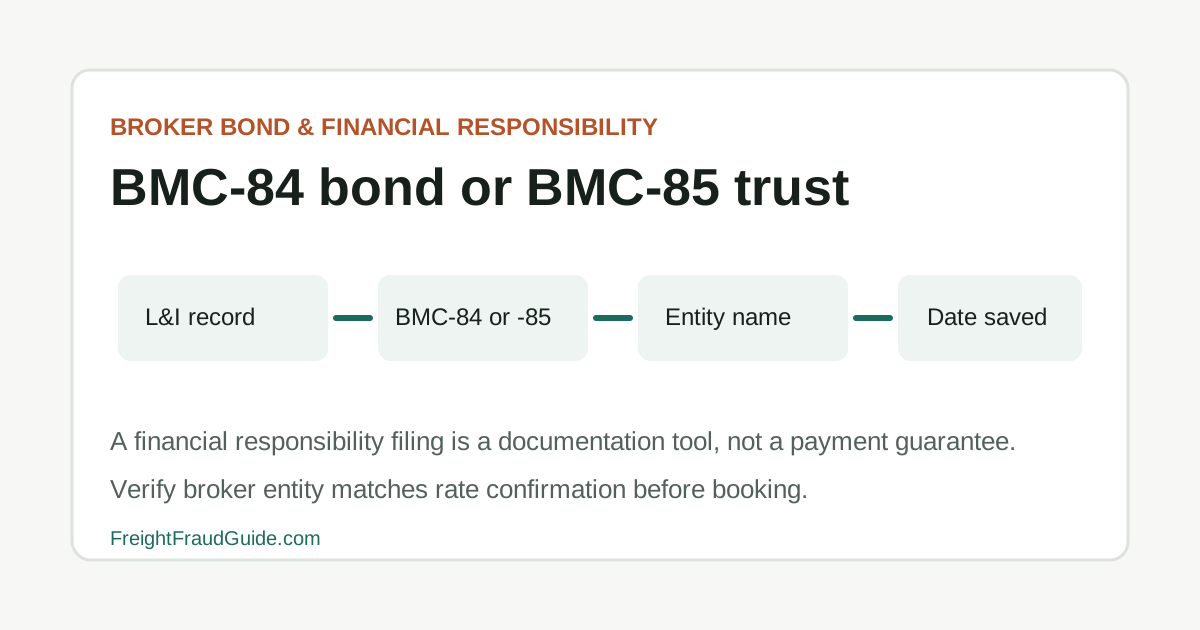
A carrier books a load with a broker whose load board credit score shows green across the board and whose payment history on the rating platform shows no visible issues. The MC number is active; the credit indicator is prominent. The load moves, delivers, and invoices on 30-day terms. On day 33, the broker's L&I record — checked for the first time after the dispute started — shows the financial responsibility filing lapsed two weeks before the booking date. The credit tool's data reflected a prior period when the filing was current; the lapse hadn't propagated to the platform's snapshot. Bond or trust recovery depends on whether a filing was in place at the time of the load — per the L&I record, it wasn't. A credit check and an L&I check answer different questions: the credit tool summarizes payment history, L&I confirms current regulatory status. Neither substitutes for the other. Running the L&I lookup at or close to booking — not relying on the credit platform's last-updated snapshot — is the check that surfaces a lapse before the load moves.
What credit tools measure versus what L&I records confirm
Load board credit tools and payment platforms measure historical payment behavior — how a broker has performed on prior loads, how long payments take, whether complaints have been reported by other carriers. What they don't measure is current regulatory status: whether the broker's authority is active today, whether the financial responsibility filing is current, and whether the entity you're dealing with matches the one in official records. Those are two separate data sources answering two separate questions. For adjacent verification steps, compare this with Broker Payment History Red Flags, Broker Bond / BMC-84 / BMC-85 Explained, and Quick Pay Red Flags.
The operational consequence is that a high credit score and a lapsed bond filing are not mutually exclusive. A broker who has paid every invoice for three years can have an authority change, a financial responsibility lapse, or a new ownership structure that no credit platform captures in real time. The L&I check confirms current status directly from the official record — the credit score can't substitute for it.
The most useful pre-booking payment review uses both inputs in sequence: L&I first to confirm authority, financial responsibility, and entity name; credit context second to calibrate documentation discipline for the load. The L&I check answers a binary question — is the regulatory status current? — that the credit score doesn't address. Both are useful; neither replaces the other.
Key Takeaways
- Keep the rate confirmation, invoice, POD, accessorial approval, and payment terms together.
- Verify payment-direction changes through a known contact before updating instructions.
- Preserve factoring notices, NOAs, remittance emails, and dispute messages.
- Use official complaint and bond or trust resources only after the document trail is organized.
What credit tools do and don't replace in a payment-risk review
A broker credit check is one input into a payment-risk decision, not the final answer. Load board credit scores, DAT or Truckstop ratings, and similar tools reflect historical data that may not capture a recent authority change, new ownership, a specific dispute pattern, or a sudden change in payment behavior.
The most direct pre-load payment-risk signal is the written rate confirmation: which broker entity is named, what the specific payment terms are, whether authority and financial responsibility are current in L&I at the time of booking, and whether the payment instructions match what has been used in prior loads with this entity. Credit tools supplement that review; they don't replace it.
What credit tools do and don't replace in a payment-risk review checklist
- Whether the broker entity name and MC number are consistent across the rate confirmation, L&I, and any credit tool used
- Whether authority and financial responsibility are currently active in L&I at the time of the load
- Whether payment terms are written on the rate confirmation rather than communicated verbally
- Whether prior payment experience with this entity, if any, matches the terms on file
- Whether any credit tool used has a documented date and methodology that can be preserved with the load record
Payment records to organize first
Payment review starts with the invoice package: rate confirmation, POD, accessorial approvals, payment terms, and any notice of assignment. In this guide, that starts with credit checks, official records, saved terms, and limits of payment screening.
The file should distinguish missing paperwork from a disputed fact, because those two problems move through different channels. Keep the question practical: what changed, who introduced it, and which dated record can be saved before anyone acts on it.
Payment records to organize first checklist
- Keep the rate confirmation, invoice, POD, accessorial approval, and payment terms together.
- Verify payment-direction changes through a known contact before updating instructions.
- Preserve factoring notices, NOAs, remittance emails, and dispute messages.
- Use official complaint and bond or trust resources only after the document trail is organized.
What the payment file can show
For broker credit check basics, the useful record is usually the one that shows where credit checks, official records, saved terms, and limits of payment screening first entered the file.
That record is stronger when it sits beside the dated lookup, the original message, and a note from the accounting, factoring, or dispute contact. It is weaker when it has been renamed, cropped, forwarded without headers, or separated from the transaction timeline.
What the payment file can show checklist
- Record the name, number, document field, contact path, or instruction tied to credit checks, official records, saved terms, and limits of payment screening.
- Keep the original file or message before saving a marked-up copy.
- Add the source URL, access date, sender identity, and who confirmed or contradicted the detail.
When accounting should hold the file
Hold the payment, dispute, or remittance decision when the file depends on a new contact path, revised document, missing official record, or mismatch that no one has explained.
The pause should be narrow and written down: the field that does not line up, the source used to check it, and the person or channel that must answer before the work continues.
When accounting should hold the file checklist
- Name the exact field or instruction that does not line up.
- Save the document version or message that introduced the mismatch.
- Check the official or independently known source before using the new detail.
- Record the confirmation result before continuing.
What to preserve for dispute or escalation
Payment records should be saved in the order they were created, especially when instructions or factoring details changed midstream. In this guide, that starts with credit checks, official records, saved terms, and limits of payment screening.
Keep remittance messages and dispute replies with timestamps so an aging file does not depend on memory. Keep the question practical: what changed, who introduced it, and which dated record can be saved before anyone acts on it.
What to preserve for dispute or escalation checklist
- Invoice and aging notes
- Signed POD or delivery confirmation
- Rate confirmation and accessorial approvals
- NOA, factoring, or payment-assignment records
- Broker accounting emails and dispute messages
Questions to answer before escalating
Payment questions should identify which document supports the amount, the payee, and the timing. In this guide, that starts with credit checks, official records, saved terms, and limits of payment screening.
When a dispute may involve contract, bond, trust, factoring, or collection issues, the documentation should be organized before professional review. Keep the question practical: what changed, who introduced it, and which dated record can be saved before anyone acts on it.
Questions to answer before escalating checklist
- Which rate confirmation supports the invoice?
- What POD or accessorial record is missing?
- Who requested the payment-direction change?
- Which broker entity appears in L&I and payment terms?
Assumptions that complicate disputes
Payment risk content must stay inside documentation boundaries. A checklist can prepare a file, but it cannot decide legal rights or recovery options. In this guide, that starts with credit checks, official records, saved terms, and limits of payment screening.
Avoid treating silence, delay, or a dispute as proof of fraud without records showing what happened. Keep the question practical: what changed, who introduced it, and which dated record can be saved before anyone acts on it.
Assumptions that complicate disputes checklist
- Do not assume non-payment proves fraud.
- Do not assume an NOA answers every payment question.
- Do not assume a bond filing guarantees recovery.
- Do not send private accusations as a substitute for records.
When to move the dispute to the next channel
Move the issue to the next channel when the invoice package is complete enough for a qualified reviewer or official complaint path. In this guide, that starts with credit checks, official records, saved terms, and limits of payment screening.
That may involve broker accounting, a factoring contact, a bond or trust process, qualified counsel, or FMCSA channels depending on the facts. Keep the question practical: what changed, who introduced it, and which dated record can be saved before anyone acts on it.
When to move the dispute to the next channel checklist
- Payment is aging past the agreed terms.
- The broker disputes facts not reflected in the file.
- A factoring or NOA conflict affects remittance.
- A bond, trust, complaint, or legal deadline may be involved.
Source Notes
Source context for Broker Credit Check Basics
For payment-risk topics, FMCSA Licensing & Insurance confirms broker authority and financial responsibility (BMC-84 bond or BMC-85 trust). NCCDB is a complaint-tracking system, not a payment-enforcement mechanism. FBI IC3 handles cyber-enabled payment fraud. For payment disputes, the load documentation — invoice, POD, rate confirmation, NOA — supports but does not replace legal or factoring-company review.
FAQ
If a broker's credit score drops after I book a load, am I at risk?
The rate confirmation and your documentation are your primary protection once a load is booked. A post-booking credit change is worth noting but doesn't require immediate action on its own — your records, POD, and invoice documentation are what matter if a dispute arises.
What's the most reliable payment indicator for a broker I've never worked with?
The combination of current L&I authority and financial responsibility status, the written payment terms on the rate confirmation, and whether carriers in your network have been paid consistently by this entity. A load board credit score is a supplementary data point — not a primary indicator and not a substitute for the official record check.
Should I check broker credit before or after accepting a load offer?
Before accepting, or at minimum before dispatch. A credit concern discovered after accepting but before pickup leaves more options than one surfaced after freight has moved. Document the date of any credit check you run so the record reflects the broker's status at the time of the booking decision.
Source References
- Licensing & Insurance Public Federal Motor Carrier Safety Administration. primary source. Last checked 2026-06-02. Official public portal for authority, insurance, and broker financial responsibility records.
- National Consumer Complaint Database Federal Motor Carrier Safety Administration. primary source. Last checked 2026-05-28. Official FMCSA complaint portal for eligible motor carrier, broker, safety, and registration-related issues.