
How this comes up in practice
The documentation gap that most often slows a non-payment claim: the carrier has proof of delivery on hand but not in a form the factoring company or broker's accounts payable can act on. A photograph of a signed delivery slip is a useful reference. It is not the same as an official POD that includes the carrier name, load number, and receiver signature in the required format. The BOL with the receiver's stamp is a separate document that also needs to be in the file. Whether the dispute goes through a factoring company, a bond claim, or legal counsel, both the POD and the BOL need to be present. Building that file before a dispute starts takes less time than reconstructing it after one has begun.
What the file needs to be before escalation is useful
Non-payment escalation has more options early in the timeline than late. Bond and trust claim processes have deadlines. Legal options narrow as time passes. Official complaint channels work better when supporting documentation is organized. The window matters, and the file assembled before escalating determines how effectively each channel can be used. For adjacent verification steps, compare this with Broker Non-Payment Checklist, Broker Bond / BMC-84 / BMC-85 Explained, and POD and Delivery Confirmation Risk.
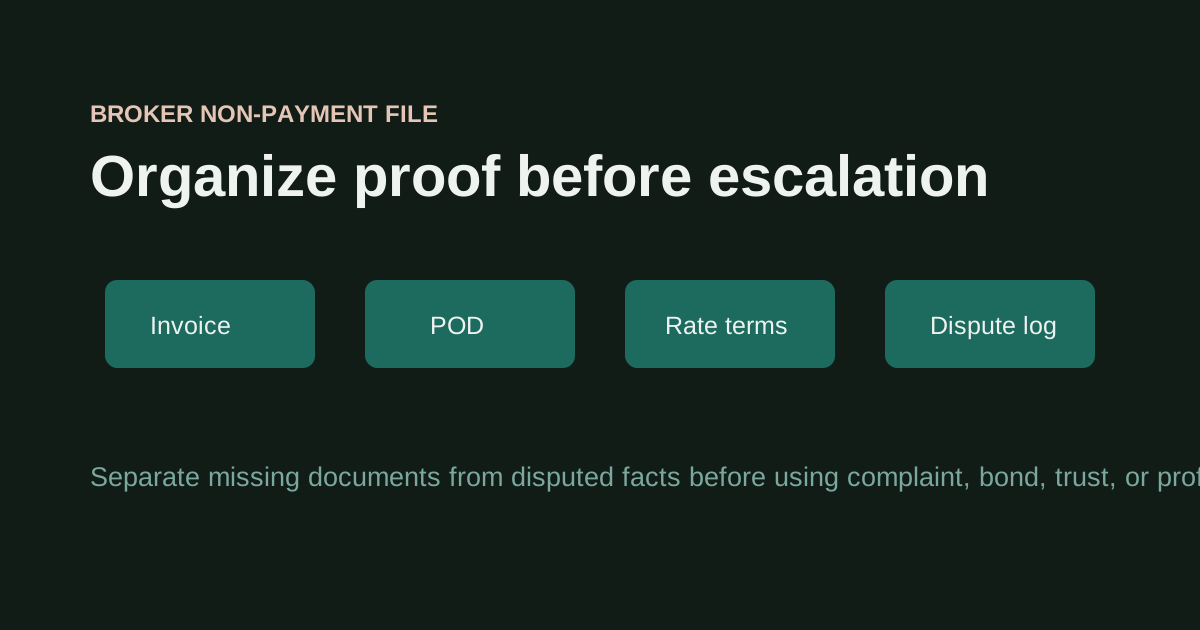
A non-payment file ready for escalation has specific components: a rate confirmation showing the broker entity and payment terms, an invoice showing the amount owed and submission date, a POD confirming delivery, and a record of any communication about the payment status. Missing any of these doesn't prevent escalation — it means the escalating party is working with an incomplete record.
A documentation gap that surfaces in non-payment situations is the POD submission record — proof not just that a POD exists, but that it was sent to the correct broker contact on a specific date through a verifiable channel. A POD in the carrier's own file is not the same as documented proof that the broker received it.
Key Takeaways
- Rate confirmation
- Invoice
- POD
- BOL
- Accessorial approvals
- Payment emails
- Factoring NOA
- L&I broker record
What to organize before escalating
Organize the payment file before escalating the dispute.
The first task is to prove the load, rate, delivery, invoice, and payment terms with dated records.
What to organize before escalating checklist
- Gather invoice and POD.
- Confirm broker entity.
- Check payment terms and any factoring notice.
Non-payment records to collect
For this workflow, build the file around rate confirmation and invoice. Keep the first version separate from later corrections so the sequence remains clear.
Non-payment records to collect checklist
- Rate confirmation
- Invoice
- POD
- BOL
- Accessorial approvals
- Payment emails
- Factoring NOA
- L&I broker record
Non-payment signals worth investigating
Treat "Broker entity differs from rate confirmation" as a reason to slow the transaction and document a call-back. It is not, by itself, a public accusation or final finding.
Non-payment signals worth investigating checklist
- Broker entity differs from rate confirmation
- Payment direction changed
- POD disputed without detail
- Aging timeline unclear
- No written accessorial approval
Questions to answer before escalating a dispute
Start with the question "What invoice is unpaid?" and tie the answer to a record, known contact, or dated instruction.
Questions to answer before escalating a dispute checklist
- What invoice is unpaid?
- What date did payment become due?
- Who received the POD?
- Does an NOA affect payment direction?
- Which official complaint or bond resource is relevant?
Non-payment assumptions to avoid
The main trap here is assuming too much from an incomplete file. In particular: Do not assume non-payment proves fraud.
Non-payment assumptions to avoid checklist
- Do not assume non-payment proves fraud.
- Do not assume a bond claim is simple or assured.
- Do not threaten public exposure as a collection tactic.
Official non-payment resources
Use FMCSA NCCDB as a comparison point and save the lookup date. Official status can change, and legitimate company records can be impersonated.
Official non-payment resources checklist
- FMCSA NCCDB
- FMCSA How to File a Complaint
- FMCSA L&I
- Broker financial responsibility rule page
When a non-payment dispute requires escalation
Escalate when the file reaches a concrete unresolved point, such as: Payment deadline passed and records are complete. Preserve the evidence and move the question to the right internal, insurance, legal, law-enforcement, or official reporting channel.
When a non-payment dispute requires escalation checklist
- Payment deadline passed and records are complete.
- Broker financial responsibility or entity is unclear.
- A factoring or assignment dispute appears.
- Legal deadlines may apply.
Source Notes
Start with documents, not accusations
FMCSA resources can help locate complaint and financial responsibility information, but payment disputes may involve contracts and legal deadlines.
FAQ
How long should I wait before escalating a broker non-payment?
The rate confirmation payment terms define the deadline. Once that date passes with a POD on file, the invoice is overdue. Escalation should begin promptly after the deadline — not weeks later — to preserve options under the broker's bond or trust.
Can I file an NCCDB complaint about broker non-payment before pursuing other remedies?
Yes. NCCDB filing and bond, trust, or legal processes are independent channels. NCCDB creates an official record for FMCSA to review; it doesn't resolve private payment disputes or require waiting for other processes to conclude first. The complaint and other remedies can proceed on their own timelines.
What if the broker says they paid but I haven't received anything?
Ask for proof of payment: a remittance advice showing the payment date, amount, and destination account. If the payment was directed to a factoring company or a different account, that's a separate thread to trace. Don't assume non-receipt means non-payment until the payment destination is confirmed with documentation.
Source References
- National Consumer Complaint Database Federal Motor Carrier Safety Administration. primary source. Last checked 2026-05-28. Official FMCSA complaint portal for eligible motor carrier, broker, safety, and registration-related issues.
- Eligible Complaints Federal Motor Carrier Safety Administration. primary source. Last checked 2026-05-28. Explains eligible FMCSA complaint categories and jurisdiction boundaries.
- Licensing & Insurance Public Federal Motor Carrier Safety Administration. primary source. Last checked 2026-06-02. Official public portal for authority, insurance, and broker financial responsibility records.
- How to File a Complaint Federal Motor Carrier Safety Administration. primary source. Last checked 2026-05-28. FMCSA complaint filing guide for NCCDB. Includes emergency boundary language.
- Broker and Freight Forwarder Financial Responsibility Federal Motor Carrier Safety Administration. primary source. Last checked 2026-06-01. FMCSA rule page for broker and freight forwarder financial responsibility. Use carefully; it is not payment advice.
- Broker Registration Federal Motor Carrier Safety Administration. primary source. Last checked 2026-06-02. Official FMCSA broker registration page covering broker authority and financial responsibility filing requirements.