
How this comes up in practice
Carrier packet documents confirm registration details that were accurate at the time of filing. They do not confirm that the person who submitted them is currently authorized to act for that company on this specific load. The detail that most often surfaces a mismatch: the dispatcher's contact number doesn't align with what SAFER shows for the carrier — a different area code, a voicemail that carries no company name, or a callback that reaches someone with no knowledge of the load. Calling the SAFER-listed number rather than the one in the packet converts a document review into an authorization check. A packet match and a SAFER callback together are the complete verification; either one alone is not.
The point in the transaction where carrier verification matters most
Carrier verification is often treated as an onboarding process — something done when a new carrier is set up in a system. But the risk it's designed to address can appear mid-relationship, when a profile is taken over, a dispatcher changes, or a legitimate carrier's identity is presented by a different party. For adjacent verification steps, compare this with Carrier Packet Verification Checklist, Insurance Certificate Red Flags, and SAFER Company Snapshot Guide.
The SAFER Company Snapshot confirms that a registered entity exists with the status and contact information shown. It doesn't confirm that the person presenting those credentials is currently authorized by that entity for this specific load. That authorization check — a call to the SAFER-listed main number to confirm the dispatcher and this load — is what most verifications stop short of.
The window where carrier verification makes the most operational difference is between dispatch and pickup. Documents can be reviewed in advance. Authorization can only be confirmed by reaching someone at the carrier who can verify the specific dispatch. A carrier check that ends at the packet stage and doesn't include a management callback leaves the most consequential gap open.
Key Takeaways
- Carrier packet
- W-9
- Certificate of insurance
- Operating authority lookup
- Dispatch authorization
- Driver and equipment details
What to confirm before dispatch
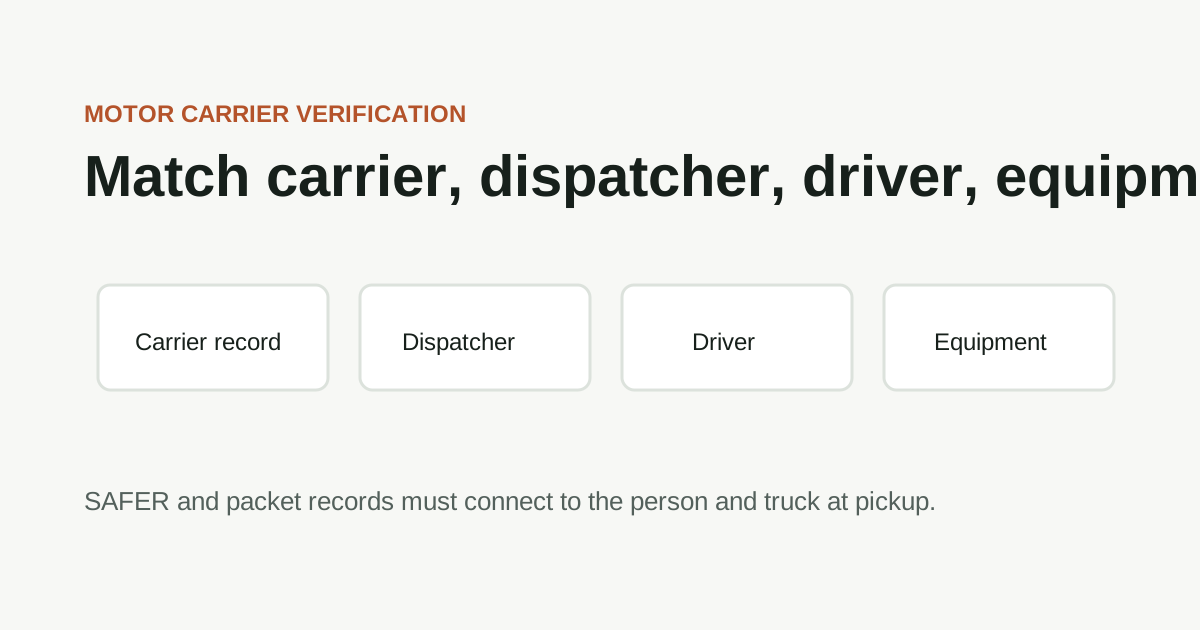
Start with the carrier legal name, USDOT number, MC number if applicable, dispatcher identity, driver, truck, and trailer.
Carrier verification should continue through pickup, not stop at packet receipt.
What to confirm before dispatch checklist
- Check official status.
- Verify contact through an independent channel.
- Compare equipment and driver details before release.
Carrier records to gather before pickup
For this workflow, build the file around carrier packet and w-9. Keep the first version separate from later corrections so the sequence remains clear.
Carrier records to gather before pickup checklist
- Carrier packet
- W-9
- Certificate of insurance
- Operating authority lookup
- Dispatch authorization
- Driver and equipment details
Carrier signals that require a call-back
Treat "Carrier contact differs from official records" as a reason to slow the transaction and document a call-back. It is not, by itself, a public accusation or final finding.
Carrier signals that require a call-back checklist
- Carrier contact differs from official records
- Dispatcher cannot connect to carrier management
- Certificate appears altered
- Truck or driver differs from dispatch record
- Payment instructions belong to another entity
Questions carrier verification should answer
Start with the question "Who authorized this dispatcher?" and tie the answer to a record, known contact, or dated instruction.
Questions carrier verification should answer checklist
- Who authorized this dispatcher?
- Which driver and equipment will arrive?
- Does insurance match the carrier entity?
- Who should shipper call if details change?
Carrier verification assumptions to avoid
The main trap here is assuming too much from an incomplete file. In particular: Do not assume packet possession proves authorization.
Carrier verification assumptions to avoid checklist
- Do not assume packet possession proves authorization.
- Do not assume a known carrier name means the current sender is legitimate.
- Do not assume dispatch service communication is enough by itself.
Official carrier records to compare
Use SAFER Company Snapshot as a comparison point and save the lookup date. Official status can change, and legitimate company records can be impersonated.
Official carrier records to compare checklist
- SAFER Company Snapshot
- L&I
- Company Safety Records
- Insurance filing references
When to hold freight and escalate
Escalate when the file reaches a concrete unresolved point, such as: Carrier denies dispatch. Preserve the evidence and move the question to the right internal, insurance, legal, law-enforcement, or official reporting channel.
When to hold freight and escalate checklist
- Carrier denies dispatch.
- Pickup staff sees different equipment.
- Insurance or authority details cannot be reconciled.
Source Notes
Carrier records can be impersonated
A real carrier record does not prove the dispatcher or driver is authorized for a specific load.
FAQ
Does a carrier passing a SAFER lookup mean it's safe to release freight?
SAFER confirms the registered identity and status for the entity on file. It does not confirm that the person at your dock is authorized by that entity for this specific load. Verification continues through pickup — match the driver and equipment against the dispatch record and confirm with carrier management if anything differs.
Should I re-verify a carrier's insurance for every load, or only for first-time carriers?
Insurance certificates can expire, be cancelled, or be issued by insurers no longer covering the carrier between loads. For frequently used carriers, a quick L&I check confirming current insurance status is faster than full re-verification. For any carrier not recently used, a fresh check is worth the few minutes it takes.
If a carrier's operating authority is active, what else still needs to be verified?
Active authority confirms registration status, not authorization for this specific load. Insurance currency, packet document accuracy, dispatcher identity, and whether the carrier's management recognizes this dispatcher and this load are all separate verification questions. Active authority is a necessary starting point, not a complete check.
Source References
- SAFER Company Snapshot Federal Motor Carrier Safety Administration. primary source. Last checked 2026-06-03. Official Company Snapshot lookup. Treat as a current record check, not a guarantee of transaction authority.
- Licensing & Insurance Public Federal Motor Carrier Safety Administration. primary source. Last checked 2026-06-02. Official public portal for authority, insurance, and broker financial responsibility records.
- Broker and Carrier Fraud and Identity Theft Federal Motor Carrier Safety Administration. primary source. Last checked 2026-06-01. FMCSA guidance on broker and carrier fraud, unauthorized USDOT use, suspicious links, SAFER phone comparison, NCCDB, OIG, FTC, and IC3 reporting pointers.
- Company Safety Records Federal Motor Carrier Safety Administration. primary source. Last checked 2026-06-03. FMCSA explanation of Company Snapshot and Company Safety Profile records.
- Insurance Filing Requirements Federal Motor Carrier Safety Administration. primary source. Last checked 2026-06-02. Official FMCSA insurance and financial responsibility filing page. Recheck for Motus-related filing changes.