
How this comes up in practice
In the first hour after suspected cargo theft, evidence that exists now may not exist later. Load board profiles are edited or deleted. Email threads go offline. Phone numbers stop routing. The file assembled in that first hour is what every subsequent process — claims, law enforcement, official reporting — depends on. Preservation runs parallel to notification rather than coming after it. The sequence that produces the most usable incident file: lock and preserve every unmodified transaction record first, then attempt contact with the carrier through every known channel and document each attempt with a timestamp, then notify the shipper and receiver, then contact law enforcement and the insurer. Each contact generates a record; the earlier those records are created, the more complete the file available for claims counsel and official reporting channels.
The sequence that makes an incident file usable
After a cargo theft, the file assembled in the first few hours determines what every subsequent process — law enforcement, insurance claims, official reports, legal review — has to work with. That file's quality is set in the immediate window after discovery, not at the time each process formally begins. For adjacent verification steps, compare this with Cargo Theft Prevention Checklist, How to Report Freight Fraud, and FTC / FBI IC3 / OIG Reporting Checklist.
The sequence matters because some actions preserve evidence while others can compromise it. Notifying parties before preserving communication thread screenshots can allow edits. Filing a complaint before capturing email headers in their original format may make the technical data investigators use unavailable. This guide follows a preserve-then-notify order because the direction is irreversible: records overwritten or deleted before documentation can't be recovered.
Law enforcement, insurers, and official reporting channels all ask for documentation that proves what the transaction was supposed to look like. The rate confirmation, carrier assignment, official lookup records, and communication trail assembled at the beginning of the incident are what answers those questions. Assembling them before any notification goes out is the most useful use of the first hour.
Key Takeaways
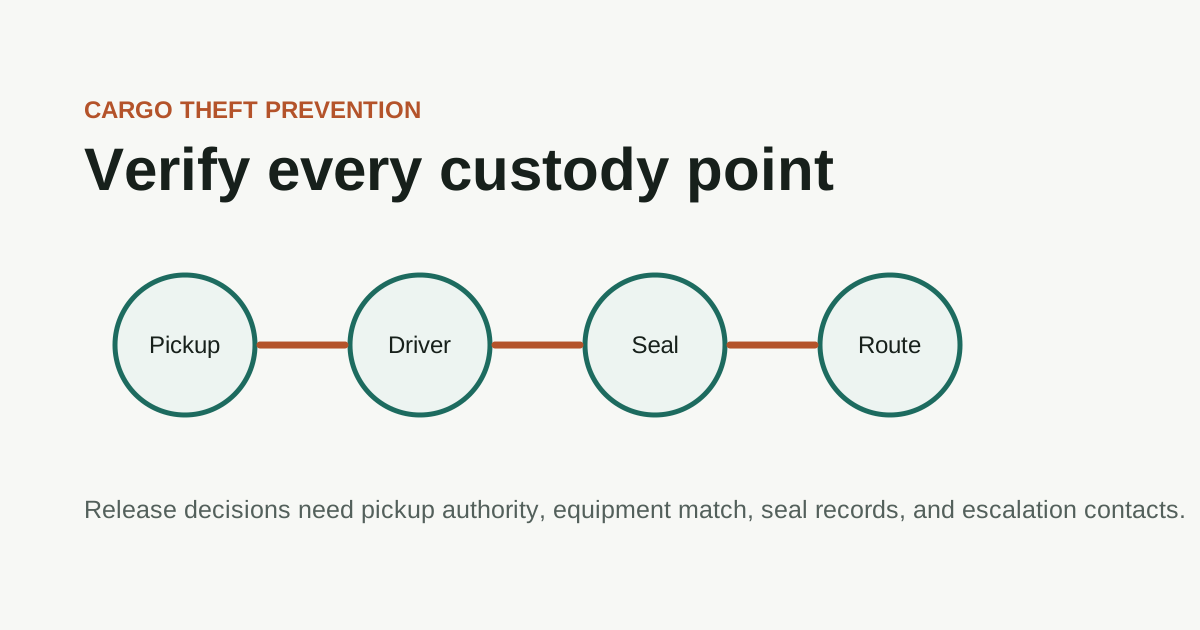
- Verify the driver, carrier, truck, trailer, and pickup number before releasing freight.
- Record seal numbers and exceptions at pickup, transfer points, and delivery.
- Use planned communication and stop procedures for sensitive freight.
- Escalate immediately when contact details, routing, or delivery instructions change unexpectedly.
Preserving the record and notifying the right parties after suspected theft
The first hours after suspected cargo theft matter because evidence disappears quickly. Load board postings get edited, profiles get deleted, email threads disappear, and phone numbers go silent. Preservation runs parallel to notifications — not after them — because some of what you'll need for reporting or claims may not be available if you wait. FMCSA guidance and law enforcement recommendations for cargo theft consistently emphasize that delay in preserving the transaction record reduces the usefulness of any subsequent report or claim — particularly when identity misuse or fictitious pickup is involved and the fraudster's trail closes quickly.
Official reporting doesn't replace internal escalation, insurer notification, and law enforcement contact. Each channel serves a different function, and the documentation assembled in the first few hours supports all of them. The sequence matters: preserve records first, then notify the parties who need to act on them.
Preserving the record and notifying the right parties after suspected theft checklist
- All transaction records — rate confirmation, carrier packet, BOL, communications, tracking data — preserved in unedited form
- Shipper and receiver contacts notified and their own records requested
- Every available contact channel attempted for the carrier or party that picked up the freight
- Insurer and any applicable bond or trust party notified
- Law enforcement contacted where appropriate; IC3 report filed if cyber-enabled elements are present
Records to lock down immediately after discovering suspected theft
Cargo theft prevention ties identity checks to custody points: pickup, stops, seal changes, route exceptions, and delivery. In this guide, that starts with preserving records, contacting involved parties, and reporting through official channels.
The file should show not only who was assigned, but who actually took control of the freight and under what release instruction. Keep the question practical: what changed, who introduced it, and which dated record can be saved before anyone acts on it.
Records to lock down immediately after discovering suspected theft checklist
- Verify the driver, carrier, truck, trailer, and pickup number before releasing freight.
- Record seal numbers and exceptions at pickup, transfer points, and delivery.
- Use planned communication and stop procedures for sensitive freight.
- Escalate immediately when contact details, routing, or delivery instructions change unexpectedly.
What to preserve before the first notification goes out
For what to do after cargo theft, the useful record is usually the one that shows where preserving records, contacting involved parties, and reporting through official channels first entered the file.
That record is stronger when it sits beside the dated lookup, the original message, and a note from the shipper, warehouse, broker, or carrier security contact. It is weaker when it has been renamed, cropped, forwarded without headers, or separated from the transaction timeline.
What to preserve before the first notification goes out checklist
- Record the name, number, document field, contact path, or instruction tied to preserving records, contacting involved parties, and reporting through official channels.
- Keep the original file or message before saving a marked-up copy.
- Add the source URL, access date, sender identity, and who confirmed or contradicted the detail.
Questions that establish what happened and who was involved
Hold the pickup, release, route, or incident-response decision when the file depends on a new contact path, revised document, missing official record, or mismatch that no one has explained.
The pause should be narrow and written down: the field that does not line up, the source used to check it, and the person or channel that must answer before the work continues.
Questions that establish what happened and who was involved checklist
- Name the exact field or instruction that does not line up.
- Save the document version or message that introduced the mismatch.
- Check the official or independently known source before using the new detail.
- Record the confirmation result before continuing.
What a law enforcement report doesn't replace in the documentation file
Preserve custody records close to the event, while pickup staff, dispatch, and tracking contacts still have fresh details. In this guide, that starts with preserving records, contacting involved parties, and reporting through official channels.
For sensitive freight, communication records and route exceptions can be as important as the BOL. Keep the question practical: what changed, who introduced it, and which dated record can be saved before anyone acts on it.
What a law enforcement report doesn't replace in the documentation file checklist
- Pickup authorization and pickup number
- Driver, truck, trailer, and carrier assignment
- BOL, seal record, and route notes
- Tracking gaps or stop exceptions
- Delivery confirmation and shortage or damage notes
When the sequence of steps matters as much as completing each one
Cargo questions should confirm that the release instruction, carrier identity, driver, and equipment all match before freight leaves the facility. In this guide, that starts with preserving records, contacting involved parties, and reporting through official channels.
If something changes in transit, the contact path should already be written down. Keep the question practical: what changed, who introduced it, and which dated record can be saved before anyone acts on it.
When the sequence of steps matters as much as completing each one checklist
- Who authorized release at pickup?
- Does the driver and equipment match the confirmed assignment?
- What stops or route exceptions are permitted?
- Who responds if tracking goes silent?
Further context on theft incident response
Theft prevention weakens when teams treat pickup as the final verification point. Identity and custody checks need to continue through transit. In this guide, that starts with preserving records, contacting involved parties, and reporting through official channels.
A tracking dot without a response protocol is only a record; it is not a security process. Keep the question practical: what changed, who introduced it, and which dated record can be saved before anyone acts on it.
Further context on theft incident response checklist
- Do not assume a pickup number proves authorization.
- Do not assume tracking prevents theft by itself.
- Do not ignore seal or route exceptions.
- Do not wait until delivery to investigate a contact gap.
When to escalate a theft concern
Escalate quickly when freight, identity, route, or contact details deviate from the confirmed plan. In this guide, that starts with preserving records, contacting involved parties, and reporting through official channels.
A theft concern may require internal security, carrier management, shipper notice, insurer contact, law enforcement, or IC3 when cyber-enabled activity is involved. Keep the question practical: what changed, who introduced it, and which dated record can be saved before anyone acts on it.
When to escalate a theft concern checklist
- A different driver or equipment arrives.
- Seal, route, or stop details do not match the plan.
- Tracking goes silent outside the agreed window.
- The load is missing, diverted, or released under disputed authority.
Source Notes
Source context for What to Do After Cargo Theft
For cargo theft topics, FBI cargo theft reporting and FMCSA fraud guidance are the primary federal sources. FBI IC3 handles cyber-enabled theft incidents including account takeovers that lead to fictitious pickups. FMCSA fraud guidance addresses fictitious pickup and identity-based cargo theft patterns. Law enforcement and insurers are the primary action channels for active cargo theft situations.
FAQ
Should I wait for law enforcement to confirm theft before notifying my insurer?
No — notify your insurer promptly and in parallel with any law enforcement contact. Most policies have notice requirements, and delayed notification can affect coverage. Preserve records while making both contacts.
Should I contact the load board if a profile may have been used in the theft?
Yes. Reporting to the platform documents the concern and may help other users — it's separate from law enforcement reporting. The platform can act on the account while law enforcement pursues the criminal matter. Keep records of both contacts and what each party says in response.
Who should file the law enforcement report — the carrier, broker, or shipper?
Any party with direct knowledge of the incident can file. The most complete report typically comes from whoever has the most documentation. In practice, the party with the largest financial loss often has the most incentive, but coordination among all parties — sharing documentation rather than duplicating efforts independently — produces a more complete and consistent record.
Source References
- Cargo Theft Federal Bureau of Investigation. primary source. Last checked 2026-05-15. FBI overview of cargo theft, including strategic theft trends such as identity theft, fictitious pickup, account takeover, double brokering scams, and fraudulent carriers.
- Internet Crime Complaint Center Complaint Form Federal Bureau of Investigation. primary source. Last checked 2026-05-15. Official IC3 complaint form for cyber-enabled incidents. Not a substitute for emergency response.
- National Consumer Complaint Database Federal Motor Carrier Safety Administration. primary source. Last checked 2026-05-28. Official FMCSA complaint portal for eligible motor carrier, broker, safety, and registration-related issues.