
How this comes up in practice
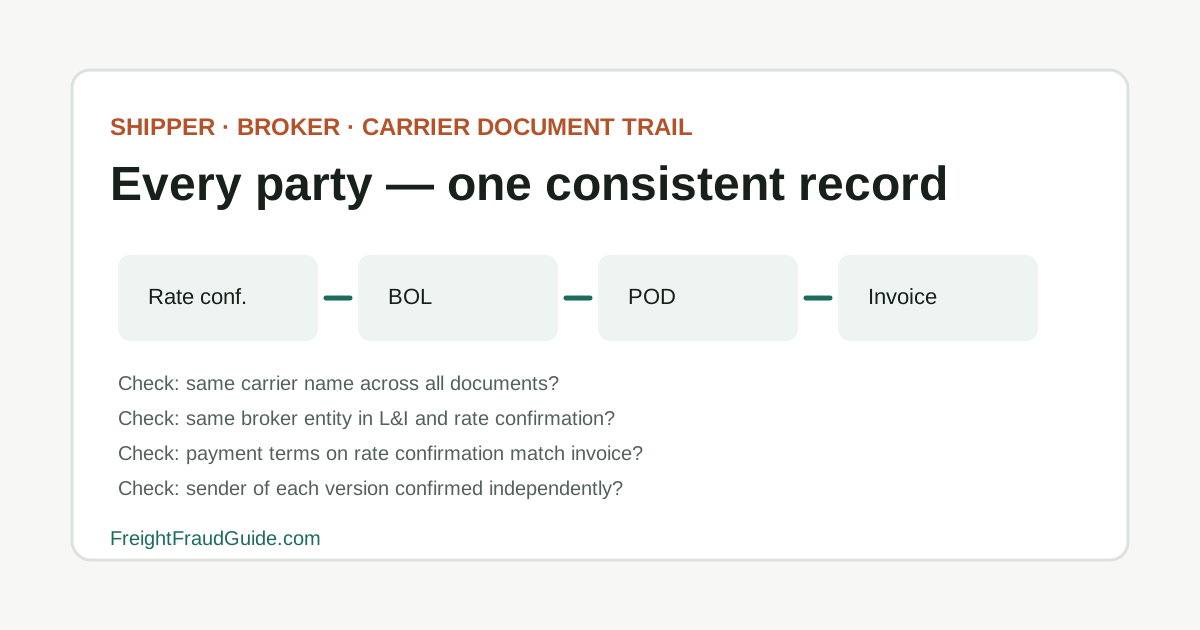
Payment disputes that are difficult to resolve often share a common root: each party in the transaction has a different version of the rate confirmation, and none were compared before freight moved. One file has the original. Another has a revision received by email. A third has a printout from the load board. When a short-pay dispute arrives, each version supports a different position. The habit that prevents this is identifying the controlling rate confirmation before the load departs, confirming that broker and carrier have the same version, and documenting that confirmation in the load file. Establishing document consistency before pickup takes less time than reconstructing it during a dispute.
What a document trail does and doesn't prove
A document trail is a reconstruction tool. When something goes wrong in a freight transaction — a cargo dispute, a payment disagreement, a question about who authorized what — the trail is what allows the relevant parties to establish a factual timeline. It doesn't prevent the problem from occurring, but it determines whether the problem can be resolved. For adjacent verification steps, compare this with Bill of Lading Red Flags, and What Documents to Save Before Pickup.
The value of a complete trail also changes over time. Documents that seem redundant at the time of a smooth transaction — a screenshot of the load board posting, a copy of the FMCSA lookup, an email confirming which version of the rate confirmation controls — become critical if any detail is later disputed. What was obvious at the time of booking may be impossible to establish a year later without the records.
A document trail gap that surfaces regularly in disputes isn't a document that wasn't created — it's one that was created but not preserved in a retrievable format. Email threads that disappear when an account is closed, screenshots that weren't saved before a load board post was edited, FMCSA lookups done but not dated — these are the gaps that matter when a dispute requires a timeline.
Key Takeaways
- Load posting
- Rate confirmation
- Broker-carrier agreement
- Carrier packet
- BOL
- POD
- Accessorial approvals
- Payment instructions
What to build into the transaction file
Build the document trail from the load offer through delivery and payment.
The goal is to make every party, instruction, and change traceable.
What to build into the transaction file checklist
- Identify shipper, broker, carrier, receiver.
- Match pickup and delivery details.
- Record who approved changes.
Documents to collect across the transaction
For this workflow, build the file around load posting and rate confirmation. Keep the first version separate from later corrections so the sequence remains clear.
Documents to collect across the transaction checklist
- Load posting
- Rate confirmation
- Broker-carrier agreement
- Carrier packet
- BOL
- POD
- Accessorial approvals
- Payment instructions
Document trail gaps worth addressing
Treat "Shipper does not match BOL" as a reason to slow the transaction and document a call-back. It is not, by itself, a public accusation or final finding.
Document trail gaps worth addressing checklist
- Shipper does not match BOL
- Carrier on BOL differs from rate confirmation
- POD comes from unconfirmed sender
- Reroute lacks written authorization
- Payment direction not tied to agreement
Questions a complete trail should answer
Start with the question "Who authorized the carrier?" and tie the answer to a record, known contact, or dated instruction.
Questions a complete trail should answer checklist
- Who authorized the carrier?
- Which document controls pickup release?
- Who approved delivery or rerouting?
- Where is payment direction documented?
Document trail assumptions to avoid
The main trap here is assuming too much from an incomplete file. In particular: Do not assume each party has the same document version.
Document trail assumptions to avoid checklist
- Do not assume each party has the same document version.
- Do not assume a verbal change is enough.
- Do not assume a BOL mismatch is harmless.
Official records to include in the file
Use SAFER and L&I for entity comparison as a comparison point and save the lookup date. Official status can change, and legitimate company records can be impersonated.
Official records to include in the file checklist
- SAFER and L&I for entity comparison
- FMCSA fraud guidance
- FBI cargo theft context
When a document gap requires escalation
Escalate when the file reaches a concrete unresolved point, such as: The named carrier and pickup carrier differ. Preserve the evidence and move the question to the right internal, insurance, legal, law-enforcement, or official reporting channel.
When a document gap requires escalation checklist
- The named carrier and pickup carrier differ.
- Receiver or shipper cannot confirm release.
- Documents suggest unauthorized rebrokering or theft risk.
Source Notes
The trail should connect every handoff
The strongest transaction file shows who tendered, who accepted, who picked up, who delivered, and who approved payment or changes.
FAQ
Which document in the trail should I preserve first if something goes wrong?
Preserve the rate confirmation and the original carrier assignment first — these establish who was authorized to move the freight. Then add the BOL, POD, and communications about changes. Act quickly, because posting histories and email threads can disappear.
When does the document trail need to stop and escalation begin?
When a document conflict or identity concern can't be resolved through the parties themselves, escalation is next — internally first, then to an insurer, law enforcement, or official complaint channel as appropriate. The trail should be as complete as possible before escalating, because the file you've built is what those channels will work from.
Does a complete document trail establish who was at fault in a dispute?
The trail establishes the factual record — what was agreed, communicated, authorized, and executed. Determining fault, liability, or legal responsibility from that record belongs to a contract review, legal counsel, insurer, or official process. The trail supports those determinations; it doesn't make them.
Source References
- Broker and Carrier Fraud and Identity Theft Federal Motor Carrier Safety Administration. primary source. Last checked 2026-06-01. FMCSA guidance on broker and carrier fraud, unauthorized USDOT use, suspicious links, SAFER phone comparison, NCCDB, OIG, FTC, and IC3 reporting pointers.
- Cargo Theft Federal Bureau of Investigation. primary source. Last checked 2026-05-15. FBI overview of cargo theft, including strategic theft trends such as identity theft, fictitious pickup, account takeover, double brokering scams, and fraudulent carriers.
- SAFER Company Snapshot Federal Motor Carrier Safety Administration. primary source. Last checked 2026-06-03. Official Company Snapshot lookup. Treat as a current record check, not a guarantee of transaction authority.
- Licensing & Insurance Public Federal Motor Carrier Safety Administration. primary source. Last checked 2026-06-02. Official public portal for authority, insurance, and broker financial responsibility records.